
Patient Journey
From our patients who trusted the process.
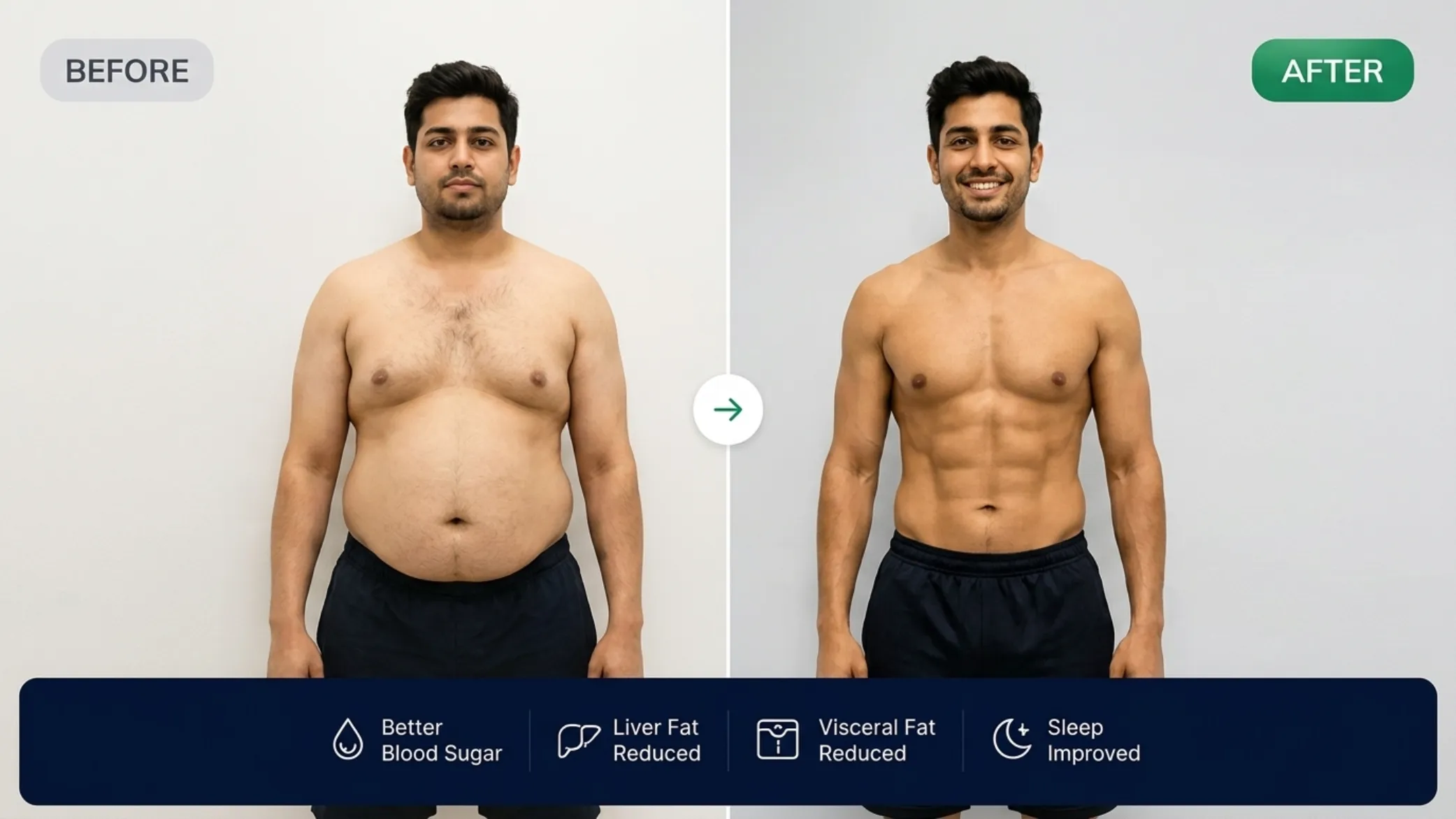
Deepanshu T., 28 — Delhi
Advanced Programme • 6 Months • Type 2 Diabetes + Fatty Liver + Obesity
−16.8 kg
in 6 months
Where He Started
Deepanshu came to Recompose Health with an HbA1c of 8.5 — well into the Type 2 diabetes range — a Grade 3 fatty liver on ultrasound, and a visceral fat score of 20. At 28, he had already been told his metabolic health was that of someone a decade older. He had tried diets, reduced carbohydrates on his own, and cut sugar from his meals, but nothing had moved his numbers in a sustained way. He wanted a medical plan, not another diet.
What His Programme Looked Like
At his discovery consultation, Deepanshu's physician reviewed his full metabolic history, existing medications, sleep quality, and his recent labs. He was placed on the Advanced tier — a 6-month programme combining GLP-1 pharmacotherapy, structured monthly dietician sessions, a clinical psychologist for his relationship with food, and a dedicated care coordinator who tracked every lab result and checked in weekly via WhatsApp.
From Month 1, his HbA1c, liver enzymes, lipids, and body composition were tracked together in a single Monthly Combined Specialist Report shared with him each month. The dietician built a protein-first, low-glycaemic eating plan around his actual glucose data — not a generic chart. His GLP-1 dose was titrated monthly by his physician based on how his labs and body were responding.
How It Unfolded, Month by Month
Month 1 | GLP-1 initiated after baseline labs confirmed his safety profile. First dietician session. Psychologist established his baseline relationship with food. Weekly check-ins began. He described the first two weeks as surprisingly manageable — appetite noticeably reduced from week two. |
Month 2 | First Monthly Combined Report shared. HbA1c had dropped from 8.5 to 7.6. Liver enzymes improving. His care coordinator called him to walk through the report in detail. “Seeing that first report was the moment I believed it was actually working,” he said. Dose adjusted upward by his physician. |
Month 4 | Mid-programme DEXA scan confirmed visceral fat had fallen from 20 to 14. Liver ultrasound at this point showed Grade 2 steatosis, down from Grade 3 at baseline. His psychologist shifted the sessions toward long-term independence and food confidence. His energy had improved enough that he had started walking daily — something he hadn't sustained in years. |
Month 6 | Final labs. HbA1c 5.4 — within normal range for the first time in years. Liver Fat Grade 1. Visceral fat score 9. A 16.8 kg reduction in total weight, with DEXA confirming lean mass had been preserved throughout. His physician reviewed his diabetes medication with his treating endocrinologist. |
His Results at Month 6
8.5 → 5.4
HbA1c
G3 → G1
Liver Fat
20 → 9
Visceral Fat
−16.8 kg
Total Weight Lost
“The Recompose program changed the way I look at my health. Better energy, better sleep and best of all — my numbers are finally in the right range.”
Deepanshu T. — 28 yrs, Delhi
Clinical Note
Deepanshu's case illustrates what happens when insulin resistance, fatty liver, and visceral fat are treated as one connected condition rather than separately. His HbA1c returning to the normal range at 28 is not just a number — it represents years of organ damage that will not happen because the intervention came early enough.
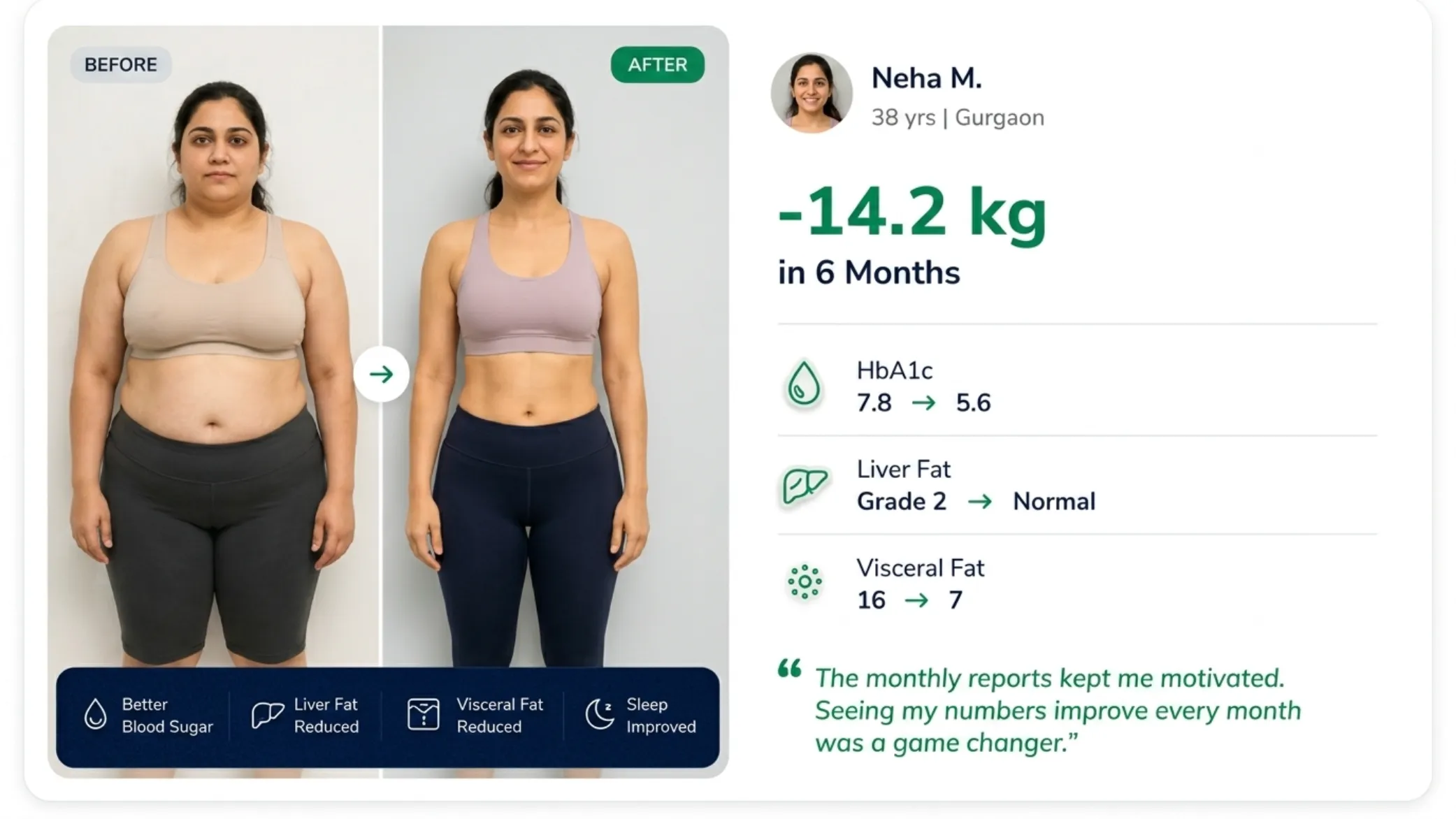
Neha M., 38 — Gurgaon
Advanced Programme • 6 Months • PCOD + Fatty Liver + Insulin Resistance
−14.2 kg
in 6 months
Where She Started
Neha arrived at Recompose Health at 38, with a decade-long PCOD diagnosis, an HbA1c of 7.8 sitting firmly in the Type 2 diabetes range, Grade 2 fatty liver on ultrasound, and a visceral fat score of 16. Her weight had been creeping up since her mid-twenties despite multiple diet attempts, and she had noticed increasing fatigue, disrupted sleep, and what she described as “cravings I couldn’t control no matter how disciplined I tried to be.”
Her gynaecologist had managed her cycle. Her GP had managed her glucose. No one had connected the two, and no one had identified the insulin resistance running underneath both conditions as the shared driver. That was where Recompose Health began.
What Her Programme Looked Like
At her discovery consultation, Neha’s physician reviewed her PCOD history, glucose markers, liver findings, and fasting insulin levels alongside her weight and sleep quality. The fasting insulin result — elevated well above the normal range — confirmed significant insulin resistance that had been present and unaddressed for years. She was placed on the Advanced tier with GLP-1 therapy initiated after careful pre-screening of her labs.
Her dietician designed an insulin-aware, low-glycaemic eating plan built specifically around her glucose data and PCOD profile. Her clinical psychologist worked on the behavioural patterns — emotional eating, late-night cravings driven by cortisol and poor sleep — that had frustrated her previous attempts. Her care coordinator managed everything in between: tracking labs, sharing her monthly report, and personally following up when her sleep-related check-ins flagged concern in Month 3.
How It Unfolded, Month by Month
Month 1 | GLP-1 initiated following baseline labs confirming safety. First dietician session focused on understanding her eating patterns around her cycle and building an insulin-aware daily structure. Psychologist established a behavioural baseline. She noticed reduced afternoon cravings within the first ten days — something no previous diet attempt had achieved. |
Month 2 | First Monthly Combined Report shared. HbA1c had moved from 7.8 to 7.1. Liver enzymes showing early improvement. Her care coordinator called to walk through the numbers. “Seeing my numbers improve every month was a game changer,” she later said. “I had always been told to just eat less and move more. This was the first time someone showed me proof it was working.” |
Month 3 | Weekly check-in responses flagged disrupted sleep and elevated stress at work. Her care coordinator escalated to the physician and psychologist. The psychologist session that month focused specifically on sleep hygiene and stress-driven eating. Her physician reviewed her blood pressure trend — which had been creeping upward — and adjusted the plan accordingly. This is the kind of mid-programme course correction that makes the difference between dropping out and finishing. |
Month 4 | Mid-programme DEXA confirmed visceral fat had dropped from 16 to 11. Liver enzymes within normal range for the first time. Her dietician shifted sessions toward food independence — building meals intuitively rather than following a rigid plan. Neha described this phase as “when I stopped feeling like I was on a programme and started feeling like I just lived differently.” |
Month 6 | Final labs. HbA1c 5.6 — returned to the normal range. Liver fat resolved to normal on Fibroscan. Visceral fat score 7, down from 16. Total weight lost 14.2 kg, with lean mass preserved throughout per DEXA. Sleep quality had improved significantly per the Epworth Sleepiness Scale. Her final Combined Report ran as an 8-page summary of six months of tracked, documented improvement — a document she shared with her gynaecologist. |
Her Results at Month 6
7.8 → 5.6
HbA1c
G2 → Normal
Liver Fat
16 → 7
Visceral Fat
−14.2 kg
Total Weight Lost
“The monthly reports kept me motivated. Seeing my numbers improve every month was a game changer.”
Neha M. — 38 yrs, Gurgaon
Clinical Note
Neha’s case demonstrates what happens when PCOD is treated as a metabolic condition rather than only a gynaecological one. Her insulin resistance — the mechanism connecting her cycle irregularity, weight gain, fatty liver, and glucose levels — had been present for years without ever being the primary focus of her care. Addressing it directly, with monthly documented feedback, produced improvements across all four conditions simultaneously. The Month 3 sleep and stress intervention also illustrates why a programme without active monitoring and a care coordinator would have resulted in dropout at that point.
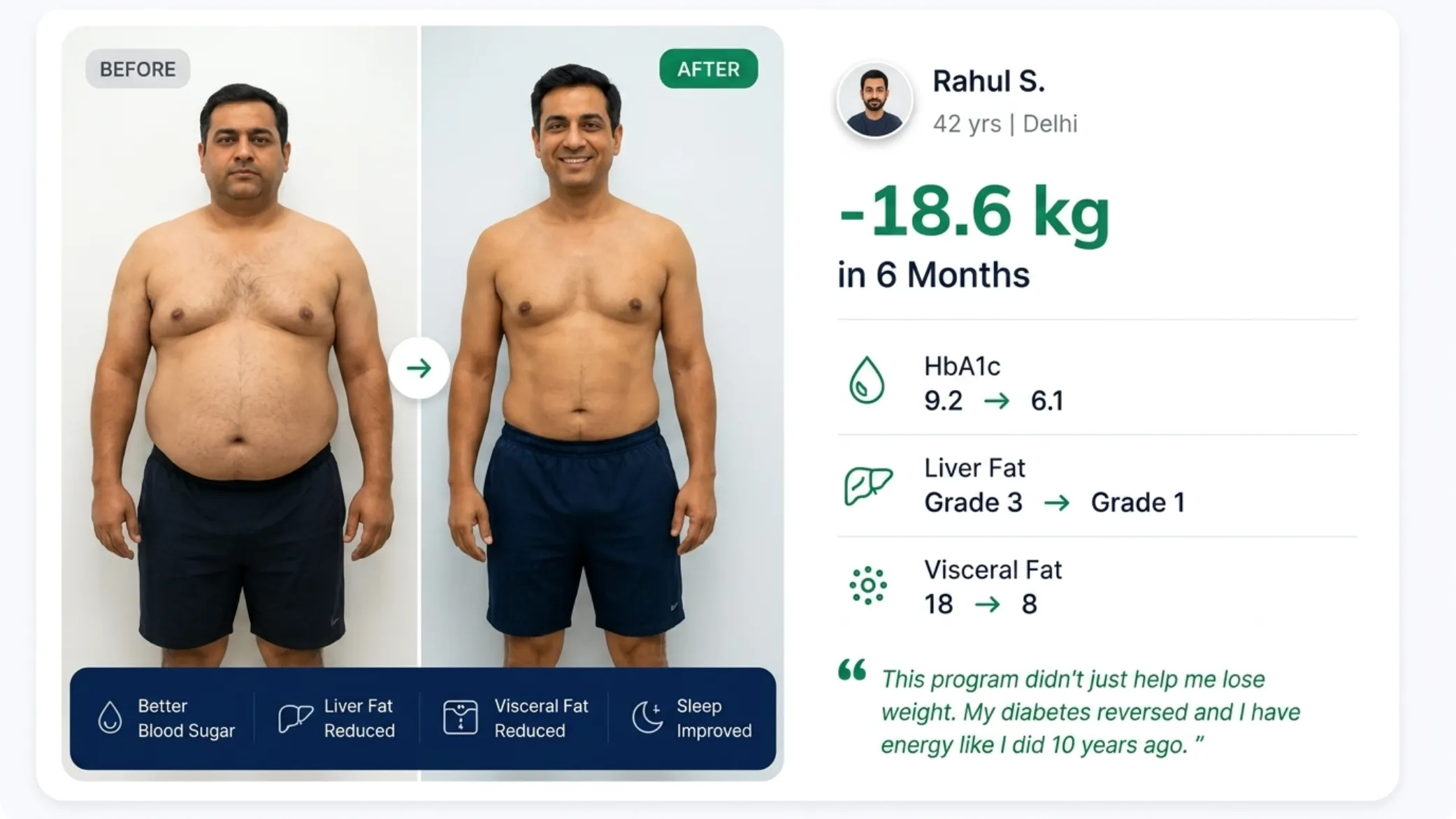
Rahul S., 42 — Delhi
Advanced Programme • 6 Months • Type 2 Diabetes + Fatty Liver + Obesity
−18.6 kg
in 6 months
Where He Started
Rahul came to Recompose Health at 42, with an HbA1c of 9.2 — squarely in uncontrolled Type 2 diabetes territory — Grade 3 fatty liver on ultrasound, and a visceral fat score of 18. Years of long work hours, frequent travel, and irregular meals had caught up with him. He described himself as “the guy who always meant to start Monday,” cycling through gym memberships and crash diets that never lasted more than a few weeks.
His GP had put him on metformin and warned him he was close to needing insulin. What he hadn’t had was a coordinated plan — something that treated his glucose, his liver, and his weight as one connected problem instead of three separate prescriptions. That was where Recompose Health began.
What His Programme Looked Like
At his discovery consultation, Rahul’s physician reviewed his glucose trend, liver findings, lipid panel, and body composition alongside his lifestyle and travel schedule. Given his HbA1c and metabolic burden, he was placed on the Advanced tier with GLP-1 therapy initiated after baseline labs confirmed it was safe to proceed.
His dietician built a plan designed around his actual routine — frequent travel, client dinners, irregular hours — rather than asking him to follow a rigid template he’d abandon within weeks. His clinical psychologist worked through the all-or-nothing thinking that had derailed every previous attempt. His care coordinator tracked his labs, compiled his monthly reports, and checked in whenever his weekly WhatsApp responses went quiet.
How It Unfolded, Month by Month
Month 1 | GLP-1 initiated following baseline labs. First dietician session focused on building a travel-friendly eating structure instead of a rigid meal plan. Psychologist established a behavioural baseline around his all-or-nothing pattern. Within the first two weeks, Rahul noticed his evening sugar cravings had dropped noticeably — something no previous diet had achieved. |
Month 2 | First Monthly Combined Report shared. HbA1c had moved from 9.2 to 7.8. Liver enzymes showing early improvement. His care coordinator called to walk him through the numbers. “Seeing the report land on WhatsApp every month kept me honest,” he later said. “I couldn’t pretend I was doing fine if the labs said otherwise.” |
Month 3 | A stretch of back-to-back business travel led to two missed weekly check-ins. His care coordinator flagged it and called directly rather than waiting for the next scheduled session. His dietician rebuilt his airport and hotel-dining strategy around what he’d actually eat, not an idealised version of it. This kind of mid-programme course correction is what kept him from quietly dropping off. |
Month 4 | Mid-programme DEXA confirmed visceral fat had dropped from 18 to 12. Liver findings improved to Grade 2 on ultrasound. His dietician shifted focus toward independence — reading his own labels, building meals on instinct rather than a printed plan. Rahul described this stretch as “the first time in years I stopped thinking about food as a fight.” |
Month 6 | Final labs. HbA1c 6.1 — down from 9.2 and out of the diabetes range. Liver grade improved from Grade 3 to Grade 1 on ultrasound. Visceral fat score 8, down from 18. Total weight lost 18.6 kg. His GP, reviewing the same reports Rahul had been receiving every month, adjusted his metformin dose downward. His final Combined Report closed out six months of tracked, documented change — the same document he later shared with his GP. |
His Results at Month 6
9.2 → 6.1
HbA1c
G3 → G1
Liver Fat
18 → 8
Visceral Fat
−18.6 kg
Total Weight Lost
“This programme didn’t just help me lose weight. My diabetes reversed and I have energy like I did ten years ago.”
Rahul S. — 42 yrs, Delhi
Clinical Note
Rahul’s case illustrates why glucose, liver, and weight need to be treated as one interconnected system rather than three separate prescriptions. His HbA1c moved from clearly uncontrolled diabetes to within normal range in six months, alongside a two-grade improvement in liver fat and a more than 50% reduction in visceral fat — changes that would not have held without the dietician’s travel-adapted plan and the care coordinator’s Month 3 intervention. A programme without active monitoring would very likely have lost him during that travel-heavy stretch.
Recompose Health | Greater Kailash I, New Delhi | 084480 46304